I grew up in the Miami Beach area. About 50 years ago, before they replenished the sand on South Beach, there were many sand crabs. My dad taught me to catch them. There were many beach birds too.
To this day I cannot locate or catch a sand crab from South Beach up to North Miami Beach. Gone permanently, as far as I can tell.
Miami Beach used to be called Golden Miami Beach because the sand was fine and a goldish color. That all changed with the thick grains from dredging. It is not that soft, fine sand anymore.
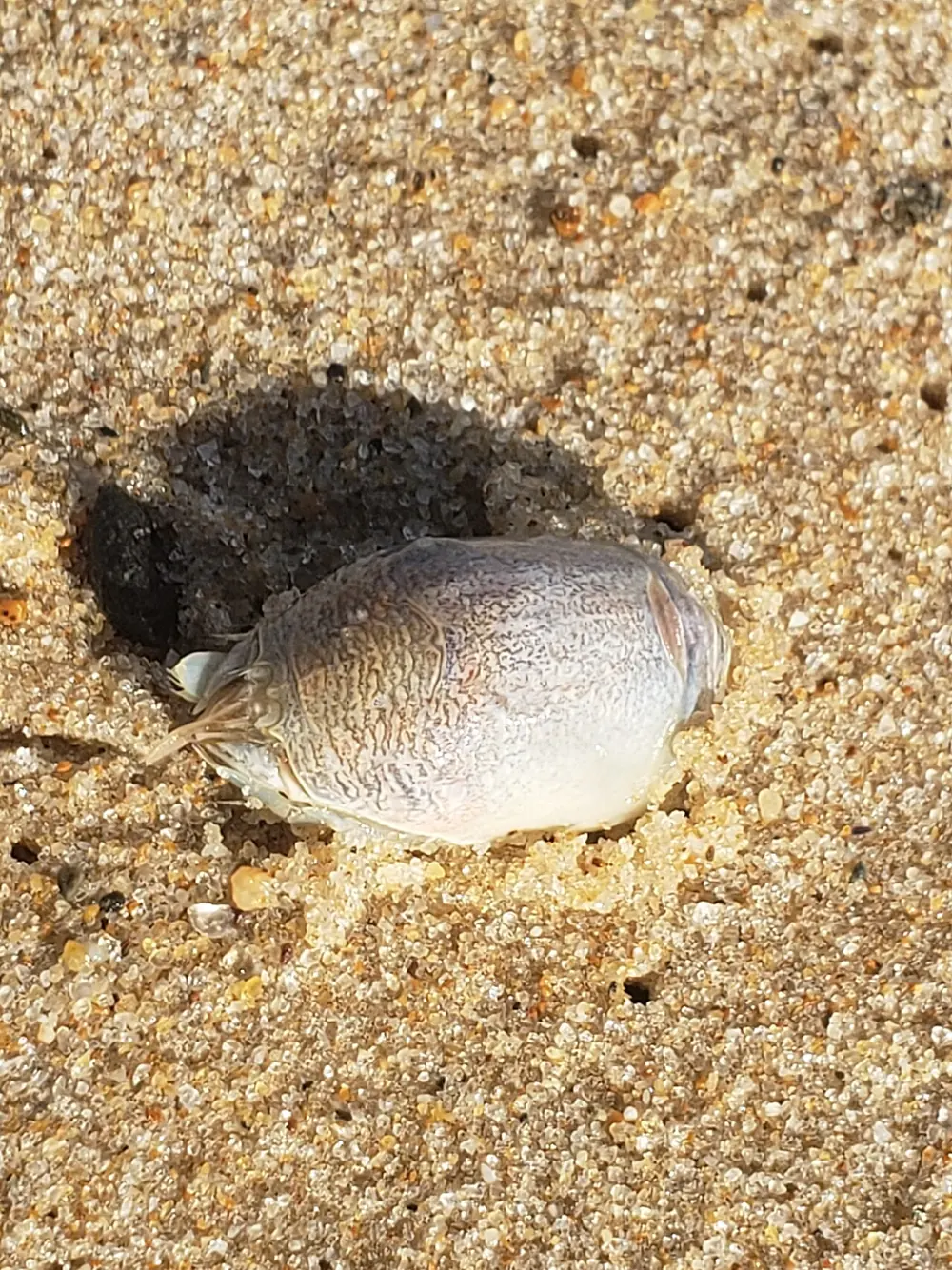
The Atlantic mole crab, also called a sand flea or sand crab. Photographed on a Long Island, NY beach, not in Miami. Photo: Jinkster1313 · CC BY-SA 4.0.
What happened
This box is SandLife's research, with sources. The nickname “Golden Miami Beach” is Peter's memory. We did not find it used as a documented historical name for the city. What the official records do show is this:
Congress authorized the Dade County Beach Erosion Control and Hurricane Protection Project in 1966 (Miami-Dade County Beach Erosion Control Master Plan ). The Army Corps of Engineers and the county then built a 10.5-mile beach fill from Government Cut through Haulover Beach Park, using sand dredged from offshore borrow sites. Construction began in 1975. The Corps says the main segment was completed in January 1982 (USACE Jacksonville District fact sheet, May 2025 ).
The county says that first 10.5 miles was built in six contracts and took 13,878,000 cubic yards of sand, at a cost of about $56.8 million (County master plan ). A later Corps report puts the initial fill at “over 12 million” cubic yards and the cost at $54.68 million, completed in phases between 1975 and 1982 (USACE Limited Reevaluation Report ).
State records break out the Miami Beach stretch itself, from the Surfside line south to Government Cut: restoration there began in 1978 and was finished in January 1982, with offshore sand. Bal Harbour, just to the north, was restored first, in 1975 (FDEP Strategic Beach Management Plan, Southeast Atlantic Coast Region, August 2026 ).
A 2015 Corps geotechnical report, looking at 1977 samples, said the original county beach sand was fine-grained (0.33 mm) and brownish-orange. The sand on the beach now, it said, is “not native beach sands” but the product of more than 25 years of nourishment from offshore. What is there now is mostly carbonate grains and shell fragments, with 35 to 40 percent quartz. The carbonate and shell material is generally coarser and darker, and the beach is typically medium-grained. Later samples measured 0.42 to 0.75 mm (USACE Appendix D, Geotechnical, January 2015 ).
After the first fill, the beach has been re-nourished many times. The first periodic job, in 1987, placed 790,000 cubic yards at Haulover Beach Park and Miami Beach (USACE Limited Reevaluation Report ). Offshore borrow sites later ran short, and more recent work has often used sand trucked from inland mines (USACE fact sheet, May 2025 ).
We have not found a published study that counts sand crabs or coquina clams on Miami Beach before and after this project. That is a gap, not a finding. Studies in North Carolina found mole crabs and coquinas 86 to 99 percent lower 5 to 10 weeks after sand was placed (Peterson et al. 2000 ; see the science ). Peter's account is a firsthand memory of this shoreline, not a scientific survey.
SandLife keeps a public Project Tracker of Florida beach-fill jobs and is asking that the animals in the sand be counted, not only the sand.
Remember the beach before? Share your story.
If you grew up here and remember the sand crabs, the birds or the old sand, we want to hear it.
Contact / Report